
CDK dependancy analysis again

Took another look at the CDK using classcycle, but this time I used the complete package that Taverna downloaded as part of the CDK plugin (which isn't working at the moment, for some reason).
The easiest way to look at the results, really, is to export them as a CSV file, and look at it with a spreadsheet. Interestingly, the results show that it is CML that has the most layers. If I am understanding the idea of layers in classcycle correctly, it means something like the longest dependency path that ends in that class.

The top hit is the DictionaryTool from org.xmlcml.cml.tools, with a layer index of 32. The first CDK class with a high layer index is CMLWriter (29) then RSSWriter but most of the top 50 are CML classes. I guess it's not a bad thing, it's just a thing. A measurement.

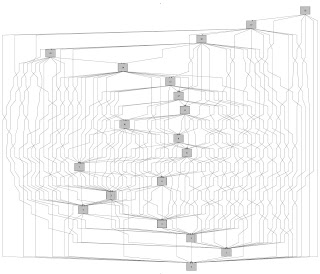
edit: heh. The eclipse plugin for classcycle made this image for CDK:


Comments

Nice blog items! Had not read my aggregator since last Thursday or so, and missed your last four!

I'll check out that class dependency stuff a bit more later... right now, the compile ensures clean build dependencies, but we still have to handcraft dependencies... and adding one (e.g. commit 12142) is cheap, but clean up is expensive...

Popular posts from this blog

The Gale-Ryser Theorem

This is a small aside. While reading a paper by Grüner, Laue, and Meringer on generation by homomorphism they mentioned the Gale-Ryser (GR) theorem. As it turns out, this is a nice small theorem closely related to the better known Erdős-Gallai  (EG). So, GR says that given two partitions of an integer ( p and q)  there exists a (0, 1) matrix   A  iff p*   dominates q such that the row sum vector r(A)  = p  and the column sum vector c(A) = q . As with most mathematics, that's quite terse and full of terminology like 'dominates' : but it's relatively simple. Here is an example: The partitions p  and q  are at the top left, they both sum to 10. Next, p is transposed to get p*  = [5, 4, 1] and this is compared to q at the bottom left. Since the sum at each point in the sequence is greater (or equal) for p*  than q , the former dominates. One possible matrix is at the top left with the row sum vector to the right, and th...

1,2-dichlorocyclopropane and a spiran

As I am reading a book called "Symmetry in Chemistry" (H. H. Jaffé and M. Orchin) I thought I would try out a couple of examples that they use. One is 1,2-dichlorocylopropane : which is, apparently, dissymmetric because it has a symmetry element (a C2 axis) but is optically active. Incidentally, wedges can look horrible in small structures - this is why: The box around the hydrogen is shaded in grey, to show the effect of overlap. A possible fix might be to shorten the wedge, but sadly this would require working out the bounds of the text when calculating the wedge, which has to be done at render time. Oh well. Another interesting example is this 'spiran', which I can't find on ChEBI or ChemSpider: Image again courtesy of JChempaint . I guess the problem marker (the red line) on the N suggests that it is not a real compound? In any case, some simple code to determine potential chiral centres (using signatures) finds 2 in the cyclopropane structure, and 4 in the ...

Adamantane, Diamantane, Twistane

After cubane, the thought occurred to look at other regular hydrocarbons. If only there was some sort of classification of chemicals that I could use look up similar structures. Oh wate, there is . Anyway, adamantane is not as regular as cubane, but it is highly symmetrical, looking like three cyclohexanes fused together. The vertices fall into two different types when colored by signature: The carbons with three carbon neighbours (degree-3, in the simple graph) have signature (a) and the degree-2 carbons have signature (b). Atoms of one type are only connected to atoms of another - the graph is bipartite . Adamantane connects together to form diamondoids (or, rather, this class have adamantane as a repeating subunit). One such is diamantane , which is no longer bipartite when colored by signature: It has three classes of vertex in the simple graph (a and b), as the set with degree-3 has been split in two. The tree for signature (c) is not shown. The graph is still bipartite accordin...